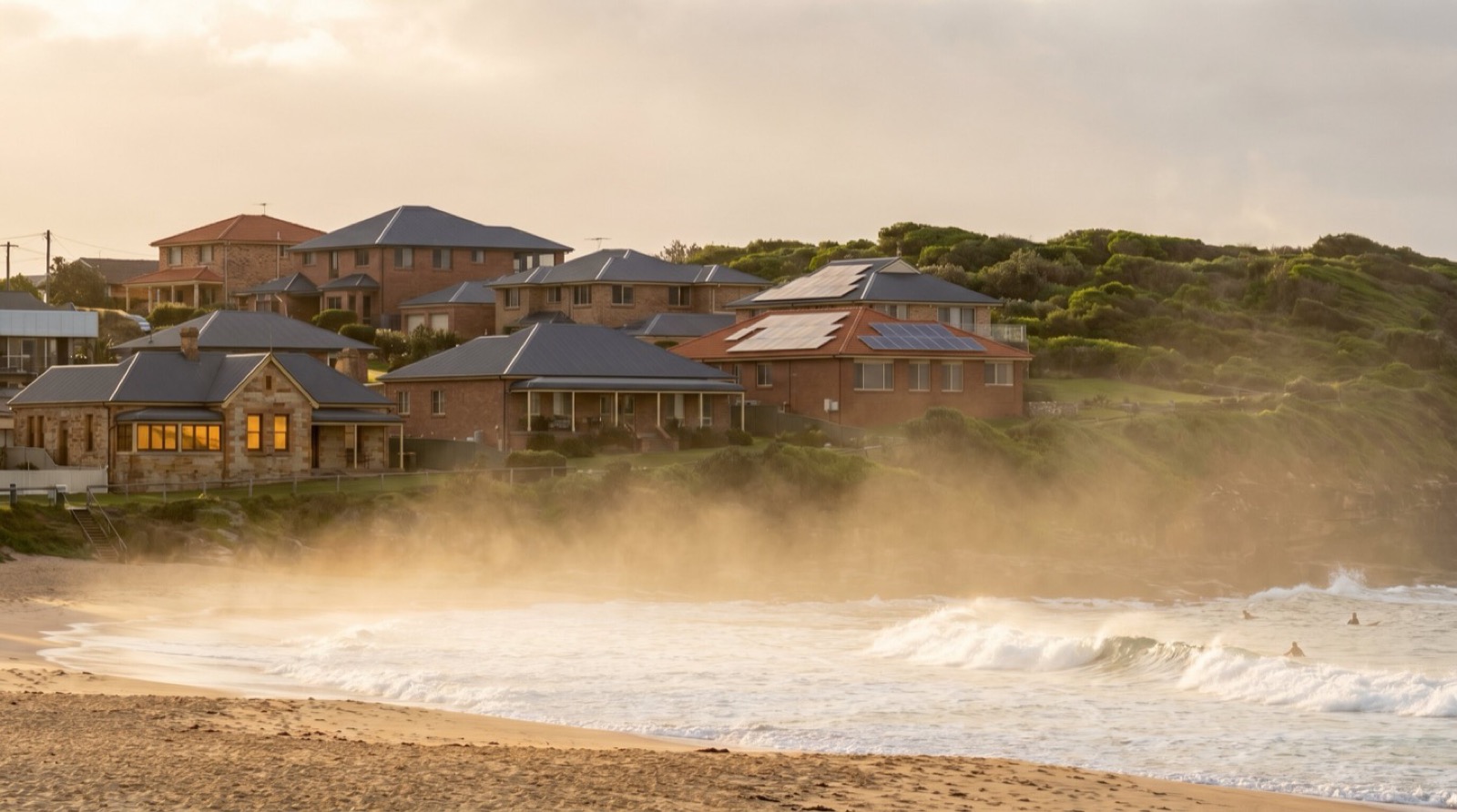
If your roof can see the surf, you've probably wondered whether the sea air is quietly eating your solar. It's a fair question, and the honest answer isn't "she'll be right" or a sales scare. There's an actual national standard behind it, a real coast-to-bush gradient across Newcastle, and a couple of practical things that genuinely change on a seaside roof.
Newcastle is a coastal city in the truest sense. From Nobbys and Newcastle East around to Bar Beach, Dixon Park and Merewether, and across the harbour mouth to the Stockton spit, an awful lot of Novocastrian roofs sit within sight and smell of breaking surf. That's a wonderful place to live. It also means the air carries salt, and salt is the single biggest driver of metal corrosion in this country.
So does that mean solar is a bad idea near the beach? Not remotely. Coastal homes go solar all the time, and they do brilliantly on sunshine. What it means is that a good installer specifies the hardware a little differently near the surf than they would out in the western estates, and a cheap quote that treats a Bar Beach roof exactly like a Fletcher one is quietly cutting a corner you'll pay for in a decade. This is the part nobody explains, so let's actually explain it.
Australia has a national standard specifically for how corrosive the outdoor air is in a given spot: AS 4312, "Atmospheric corrosivity zones in Australia", which lines up with the international ISO 9223 scheme. It sorts the whole country into categories from C1 (bone-dry indoors) up to C5 (open ocean surf), based mostly on how much salt and moisture the air carries. The Standards Australia categories look like this:
| Category | Rating | Steel loss (µm/yr) | Typical environment |
|---|---|---|---|
| C1 | Very low | <1.3 | Dry indoors |
| C2 | Low | 1.3–25 | Arid / urban inland |
| C3 | Medium | 25–50 | Coastal / industrial |
| C4 | High | 50–80 | Marine (calm water) |
| C5 | Very high | 80–200 | Marine (ocean surf) |
Look at the jump from C3 to C5: unprotected steel wastes away up to four times faster in ocean-surf air than in ordinary coastal-suburb air, and roughly a hundred times faster than it does indoors. Solar racking and fixings aren't bare mild steel, of course, they're chosen to resist this. But the category your roof sits in is exactly what decides which grade of metal is the right one. That's not marketing colour. It's the standard installers are meant to work to under the Clean Energy Council's national solar installation rules, and it's the bit a rushed quote skips.
Here's where the local knowledge earns its keep. The rule of thumb most of the industry quotes, and it's written into AS 4312 itself, is that salt's influence usually fades within about a kilometre of the coast. The Australian Steel Institute puts it plainly:
"The influence of chlorides does not normally extend more than a kilometre from the coastline, although there are exceptions in flat terrain with prevailing strong on-shore winds."
— Australian Steel Institute, summarising AS 4312
Read that second half again, because it's Newcastle in a sentence. A sheltered harbour or a calm lake throws salt a short distance, often only tens of metres to a kilometre. An open surf beach is a different animal: breaking waves fling salt aerosol into the air, and a prevailing onshore wind can carry it several kilometres inland across low, flat, exposed land before it settles out. Newcastle's east-coast suburbs are precisely that setup, surf beaches on low-lying land with the sea breeze pushing straight in off the Pacific. So the tidy "one kilometre and you're fine" line is a starting point here, not a boundary.
The genuinely honest reading, then, isn't a scary one. It's just: near the open surf, assume a higher corrosion category and spec accordingly; a few kilometres back on the ordinary suburban streets, it eases off; out west it's a non-issue. The sea decides the metal. Here's what that gradient actually looks like across the suburbs we work in.
Elevations are real ground heights from public G-NAF address-point data (Bar Beach 16.1 m, Merewether 11.2 m, New Lambton 13.4 m, Fletcher 7.9 m); distances are straight-line from the Bar Beach shoreline (Merewether 1.42 km, New Lambton 5.62 km, Fletcher 13.74 km). The corrosion-zone bands follow the AS 4312 / ISO 9223 distance method as described by the Australian Steel Institute and referenced in Clean Energy Council installation guidance. No AS 4312 category is assigned to any individual address, that's a judgement made on site. The methodology note shows every figure and source. Nothing here is a price.
A couple of honest wrinkles the picture deliberately leaves off the line. Newcastle East and Stockton each front their own surf or harbour water, so their distance from Bar Beach (2.4 km and 3.1 km respectively) tells you nothing about their own salt exposure, they sit near-shore on their own frontage regardless. And Dixon Park, the stretch of coast between Bar Beach and Merewether, is a beach name rather than a suburb, so it's a landmark on the map, not a pin with its own numbers. The full set of measured figures, including those two, is in the table below.
| Suburb | Straight-line from surf | Elevation | Coastal character | What the distance logic suggests |
|---|---|---|---|---|
| Bar Beach | Beachfront (0 km) | 16.1 m | Open surf | Near-shore · C4–C5 range |
| Newcastle East | Own surf frontage | 16.5 m | Open surf headland | Near-shore on its own coast |
| Stockton | Own ocean / harbour spit | 7.0 m | Low, exposed spit | Near-shore, low-lying |
| Merewether | 1.42 km | 11.2 m | Surf-facing, low | Surf-exception belt · C4–C3 |
| New Lambton | 5.62 km | 13.4 m | Established inner ring | Inland, easing · C3–C2 |
| Fletcher | 13.74 km | 7.9 m | Western estate / bush edge | Ordinary inland · C2 |
This is the payoff, and it's smaller and more practical than the word "corrosion" makes it sound. It comes down to three things, all of which a good installer handles as a matter of course near the coast.
Stainless steel isn't one thing. The two grades that matter for solar mounting are 304 (also called A2) and 316 (A4). The difference is a splash of molybdenum in 316, and that one ingredient is what lets it shrug off chloride, the corrosive part of salt. So the spec follows the zone:
| Corrosion category | Typical stainless grade | In plain English |
|---|---|---|
| C2–C3 (inland / ordinary coastal) | A2 / 304 | The standard grade, fine well back from the surf |
| C4–C5 (marine / surf) | A4 / 316 | Marine-grade, molybdenum added to resist salt |
Fitting 316 fixings to a beachfront roof isn't gold-plating, it's the correct spec. Fitting standard 304 to that same roof is the corner a cheap quote cuts, and you won't see it on the day, you'll see it as rust streaks and loose fixings years down the track.
Solar racking is aluminium and the fixings are stainless, two different metals. Put two different metals in contact in salty, damp air and you get galvanic corrosion, where one metal sacrifices itself to protect the other. The standard fix is dull and effective: a non-reactive isolator, usually an EPDM rubber washer, between the two so they never touch bare metal to bare metal. It's a five-cent part that matters a lot more by the sea.
The Clean Energy Council's guidance on the national installation standard, AS/NZS 5033, tells installers to check the site's AS 4312 category and, in the high categories, apply an "interface spacing reduction factor" when standard components are used. In practice that's the installer either upgrading the components or adjusting the layout so the system still comfortably meets its design life in tougher air. Again, entirely routine, as long as someone actually assessed the zone in the first place.
None of this is a reason to hold off on solar near the beach. It's a reason to make sure whoever quotes your seaside roof is specifying it as a seaside roof. The sunshine's the same either way, it's the hardware that needs to read the address.
One quick myth to clear up, because coastal homeowners often blur the two. Salt corrosion (AS 4312) is about how fast the metal degrades. Wind loading is a completely separate standard, AS/NZS 1170.2, about how hard the wind pushes on the array. They're different questions with different answers. Newcastle sits in wind Region A, the standard non-cyclonic region, so despite the surf you are not in cyclone country and you don't need cyclone-rated gear. An exposed clifftop block might get a closer look at tie-down detail because of the open sea fetch, but that's a wind judgement, not a corrosion one. Keep the two separate and you won't be talked into hardware you don't need.
You don't need to become a corrosion engineer. You just need to ask one question, and listen to whether the answer is specific or a shrug:
"What AS 4312 category are you assessing my roof as, and what fastener grade does that require?"
A good installer will tell you they'll confirm it on site, and roughly what they'd expect for your street. A quote that has no idea what you're talking about is a quote that priced your beachfront roof like it was in Fletcher.
We don't publish a corrosion rating for your address off a webpage, because it genuinely depends on exactly where you are, how exposed the block is, and which way the weather comes in. What we do is read it on the day: your distance from the open surf, your roof, your orientation and shading, and your power supply all get looked at together, and the hardware gets specified to suit. Everything you connect with is done by a CEC-accredited installer, the accreditation that's both the quality bar and the gate for the federal rebate. And the same honesty rail runs through all of it, we won't put a dollar figure or a corrosion category on your roof until we've stood on it.
The Hunter gets a genuinely good run of sun, around 4.5 to 5 peak sun hours a day across the year on the Bureau of Meteorology's solar-exposure data, and a beachfront address doesn't change that one bit. It just changes the shopping list. If you're on the coast, that's exactly the kind of detail worth getting right the first time.
Read the methodology & sources → A short note on exactly where every figure came from and how we worked it out. That visible working is the point, honest sites show it.
Elevation and distance figures are from public G-NAF address-point data, measured for this article, see the methodology note for the exact values and how they were taken. Nothing on this page is a price, a guaranteed output, a rebate amount, or a corrosion rating for a specific address. Corrosion categories are illustrative of the standard's distance logic only and are always confirmed on site. Last reviewed July 2026.